Introduction
Joseph Reagle
Me
Geek
A lot of stuff is interesting and even boring stuff can be made so.

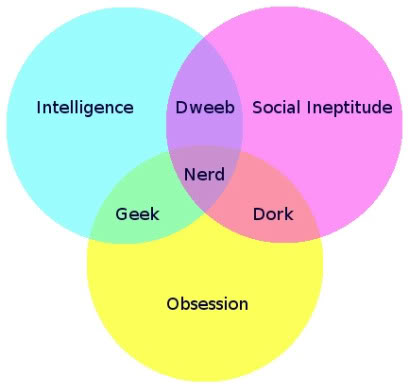
What is a geek?
Course attributes
Meaningful
- Kraut et al.’s chapters are full of fascinating social science.
- Complemented by other scholars and contemporary cases.
Engaged
- Not the sort of class where “just get Prof’s notes and you’ll get an A.”
Active
- You will be working, in and out of class on:
- collaboration,
- in class exercises, and
- public contributions.
Examples
Meta
- Meta means going a level higher and taking a bigger picture: how can we improve?
- Educational psychologists speak of meta-cognition: becoming cognizant of our learning.
- The syllabus is a Web page, with links to how to do everything and do it better.
Motivation
- Capstone (NU Core)
- … a culminating project and presentation including designs, artistic and dramatic works, comprehensive research or report that demonstrates and documents the culmination of the undergraduate experience.
- Experiential
- … student teaching, service-learning, …, student production, or significant student leadership. They will describe and evaluate their experiential learning by completing an appropriate report or reflection paper/presentation.
Objectives
Upon successful completion of this course you will be able to explain the dynamics of online communities including formation, joining, governance, conflict, and exit.
Furthermore, you will have experience with the development, challenges, and maintenance of online communities via hands-on interventions, such as experiments with your own online networks and via contributions to communities like Wikipedia.
Skills
- ask complex questions and have a sense of how to address them (e.g., what type of moderation is best?);
- recall, compare, and give examples of key theories related to communities (e.g., pro-social norms);
- analyze, critique, and design online communities;
- compellingly write in both a short-form online venue and longer-form academic format;
- compellingly present your ideas orally (e.g., assignment debrief);
- collaborate with one’s peers;
- contribute to Wikipedia.
Infrastructure
Syllabus
It’s the Web!
Tools like Obsidian allow you to “make information your own.”
BTW: Posting Style
In emails, click the ‘…’ to see my response.
Please see my comments below. —Dr. Reagle
…
On Tuesday, Sue wrote:
>>> Michael Pollen argues agriculture is the new industrial.
>>
>>typo: it's "Pollan" —Dr. Reagle
>>
> Thanks for noting that. — Sue

It's an easy mistake to make. —Dr. Reagle
Zip of PDFs

Course policies
| high expectations | respect |
| academic integrity | collaboration |
| gadgets | attendance |
| participation | late work |
Office hours
- see syllabus and
- “end of class” conference: write name on board
To do
Wikipedia orientation
Communicating
- QICs are posted to Wikipedia – so you get practice.
- a Question, an Insight, and a Connection from the readings
- one or two sentences each, anchored in a specific concept, example, or quotation
- posted to the QIC
page and signed with
~~~~, 90 minutes before class
- You can post to our Canvas discussion thread for show & tell, updates, etc.
Quizzes
- four unannounced quizzes each half of the term; the best two count (30 pts each)
- at the start of class, on paper, no notes or devices
- a recall question on the readings, plus: restate your Q, I, or C from that day’s QIC
- both are simple recall—a few minutes only
Two quizzes are dropped, so you can skip two QICs a half with no risk.
That is the grace—which is why there are no makeups.
Google Drive
- Exercises
- FAQ
Think about…
- what Wikipedia article you’d like to write;
- what online communities you’d like to analyze.