Individuals
Benefits
Demerits

What is going on here?
What is going on here?
- thanks signals the completion of reciprocated exchange
Can you do better??
Direct/negotiated
- ebay, craiglist
Indirect/reciprocal
- Kassi, freecycle.org
Generalized
- stranded motorists helping another on the highway
Network-generalized
- helping another student furthers class solidarity
- increase the recipient’s pro-social behavior
- doubled likelihood of someone helping a second time, increased time by 15%, and rate of work by 50%
- but “not a magic ingredient” for getting favors on Weibo (Liu and Janson 2013) (Matias 2014)
- paternalism (“you’ll thank me later”)
- supporting favoritism (you have to kiss up)
- papering over structural injustices (service tips)
The key for designers is to redirect feelings of indebtedness towards positive, participatory outcomes rather than frustration, hesitation, and non-participation. (Lampinen et al. 2013, p. 10)
(Kassi is defunct)
Please do not add a comment on your question or on an answer to say “Thank you”. Comments are meant for requesting clarification, leaving constructive criticism, or adding relevant but minor additional information – not for socializing. If you want to say “thank you,” vote on or accept that person’s answer, or simply pay it forward by providing a great answer to someone else’s question. (Overflow 2013)
On average, communities give 43 times more thanks than love. Why might that be?
. . .
Wikipedians have explained that it’s much easier to click a single link to send Thanks than to choose a picture and write someone a personal message (WikiLove). (Matias et al. 2019)
in the year leading up to June 1, 2018. People in three languages sent more than 10% of all Thanks and WikiLove to newcomers in that period. In contrast, five other languages sent less than 3% of their appreciation to newcomers. (Matias et al. 2019)
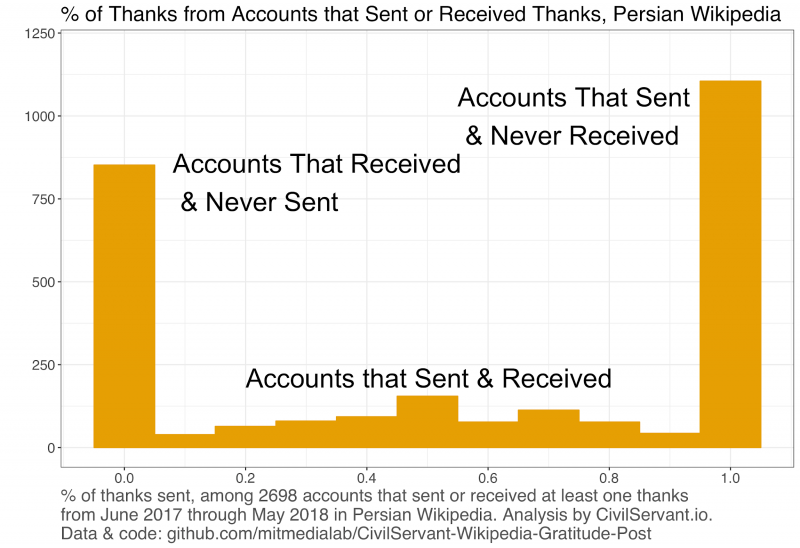
a general spirit of collegiality and mutual understanding…
If we keep this … love of knowledge, in mind, if we concentrate on achieving a [NPOV] even when it is difficult, and if we try to actually understand what the other side has to say, then we can reach the state of “WikiLove”.
If we fail to achieve WikiLove, this will only mean that the encyclopedia and its mission as a whole will suffer. Constant flamewars will scare contributors off, biased articles will drive readers away, and both will harm our reputation in the long term. (Wikipedia 2009)
This touchy-feely stuff cannot possibly be for real. Is this story from The Onion?
Praising other’s edits by clicking on a button and dropping a template is indeed about as deep as clicking “like” on Facebook–a hollow act producing a formulaic compliment (even if they can be tweaked whimsically) that requires no investment and is therefore meaningless. (Wikipedians 2021)
|
|
|
|
|
|
- Match similarity and status characteristics.
- Highlight both the unique value of a contribution and one’s role as a recipient of others’ efforts.
- Highlighting exchange processes and outcomes (successful and less so).