Breaking Up
Joseph Reagle
Breakup 2.0
What’s more important?
Norms
Scheff (1960) refers to this class of norms as “residual rules”: (1) people must be in substantial agreement about them; and (2) they are not noticed until a violation occurs. These rules have been likened to the rules of grammar in that one can follow them without an explicit knowledge of their content and yet notice a violation immediately. (Milgram & Sabini 1978, p. 31)
What was Gershon’s term for this?
Idioms of practice
By idioms of practice, I mean that people figure out together how to use different media and often agree on the appropriate social uses of technology by asking advice and sharing stories with each other. (Gershon 2010, “The breakup 2.0”, p. 6)
Difference between a norm and IoP?
Phones and answering machines
Ghosting
Modality
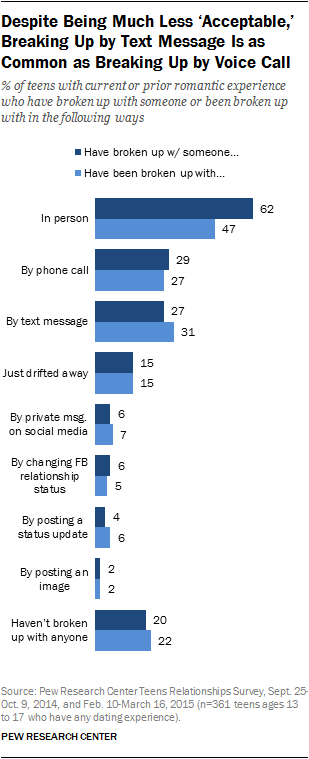
Teens consider the text message breakup to be socially undesirable, but a sizeable number of teens with relationship experience have been broken up with – or have broken up with others – using text messaging. (Lenhart et al. 2015)
Pruning
- 48% have removed someone they used to date from their cellphone’s address book.
- 38% have untagged or deleted photos of themselves and a past partner on social media.
- 37% have unfriended or blocked someone they used to be in a relationship with on social media.
- 30% have blocked an ex from texting them. (Lenhart et al. 2015)
2nd-order info?
is not what is actually said but rather the background knowledge of the situation and expectations of communication that allows one to interpret the words. (p. 123)
But … ring tones are another type of second-order information. One girl spoke that she was glad she had not used a really good song for her ex-boyfriend (p. 162)
Is there another word we could use?
“context”?
Non-relationship examples??
- subtweets
- lyrics
Gender differences in away messages?
- women attempted to use second-order information to show they were independent and thriving regardless of heartbreak
- whereas males ignored the breakup (p. 128)
Why is 2nd-order info “undetermined”?
- a woman complains that people always thought the lyrics she posted and her away message were about her peers (p. 130)
- the relationship category of “it’s complicated” exemplifies how underdetermined relationship status information can be (p. 134)
What is “creepy” in terms of 2nd-info?
- students frequently use the word creepy to describe those who ineptly manage the information flow and the second order information associated with it (p. 145)
egs of idioms/norms
- some people feel an obligation not to violate implicit norms associated with others’ profiles (p. 187)
- access to a shared password, a voicemail password, a log of text messages can be interpreted as a sign of intimacy (p. 192)
- …?
Platonic breakups
Have you been blocked/unfriended?
Definitions
ex. Define
In a 4 person group come up with a definition for public and creepy and write on board.
Use intensional, extensional, ostensive, genus-differentia, operational, or consequential.
- intensional/coactive
- necessary & sufficient conditions (bachelor: unmarried man)
- extensional/denotative
- enumerate every object in a set (primary colors: RGB)
- ostensive
- listing examples (red: apples, stop sign, roses)
- genus-differentia
- difference within a class (▭: quadrilateral with 4 ⦜)
- operational
- constitutive process (PB&J sandwich: add PB&J between two slices of bread)
- consequential
- likely outcome (humor: laughter)
What’s changed since 2010?
- have you ever unshared a streaming service?
- how do folks indicate relationship status now?
- …?
QICs
Conclusion
Wrap up
- Write a multiple choice question that tests understanding of:
- idioms of practice
- 2nd-order info
- undetermined
- creepy
Review
- Share your MCQ about:
- idioms of practice
- 2nd-order info
- undetermined
- creepy