Speech Ethics
Joseph Reagle
Our question(s)
- How to be an ethical public speaker?
- What ethical frameworks might inform our arguments?
Ethical public speaking
Avoid illegal speech
- In the U.S.A., be careful of issuing:
- threats
- defamation (libel is written, slander is spoken)
- fraud
- In many countries, also be careful of political speech, blasphemy, obscenity, etc.
Be careful with provenance
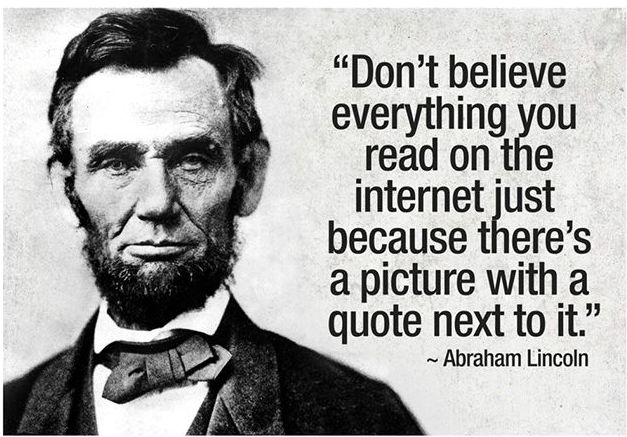
During her Republican National Convention speech earlier this week, Lara Trump declared that “Abraham Lincoln once famously said, ‘America will never be destroyed from the outside. If we falter and lose our freedoms, it will be because we destroyed ourselves.’” (Riley 2020)
Avoid plagiarism
Types of plagiarism
- stealing: taking ideas or words without credit
- self-plagiarism: resubmitting the same work
- sneaking: stealing and disguising
- borrowing: making a mistake
- confusion about “common knowledge”
- misattributing a source (Tucker 2018, p. 55)
Attribution
- carefully attribute ideas, words, and media
- explicitly or in supplementary material
- query but don’t copy AI
Ethical frameworks
The big three
- consequentialism (act so as to maximize outcome)
- deontological (act in accordance with duty/rules)
- virtue (act as an ideally virtuous/flourishing person)
Pragmatism is a framework inspired by science: test and see what works best in practice given the context (Tucker 2018, p. 276). (This is distinct from the underappreciated context and consequences of your scenario.)
Consequentialism
Given some value (e.g., happiness of yourself, of others, of everyone, etc.) “the ends justify the means.”
Utilitarianism is the most popular, and recommends actions that “most increase the total amount of happiness and decrease the total amount of pain in the world” (Gronholz 2014).
There’s also consequential egoism (maximize your utility), altruism (maximize others’ utility), and maximizing the features of other ethical systems.
Utilitarianism
Suppose your friend, on her deathbed, makes you promise to spread her ashes in the Rocky Mountains. After her death, you realize it would be much more convenient to simply flush her ashes down the toilet. You would save a lot of time and money, and no one would be harmed. (Gronholz 2014)
Do you spread the ashes?
- What if your friend’s mother finds out what you did?
- Perhaps you could be a rule consequentialist: follow rules that, when followed, lead to good consequences.
Deontology
We have an obligation, as rational beings, to act in accordance with the rules of reason, especially other rational beings.
Categorical (universal) imperative
1st formulation: Act only in accordance with that maxim through which you can at the same time will that it become a universal law.
2nd formulation: Act in such a way that you treat humanity, whether in your own person or in the person of any other, never merely as a means to an end, but always at the same time as an end. (Chapman 2014)
Trolley problem??
Do you throw the switch, push the man, or do nothing?
How would a utilitarian and Kantian respond to this question?
- utilitarian: throw the switch or push the man, no difference
- Kantian
- 1st formulation: throw the switch because “save lives when possible” could be a universal law;
- 2nd formulation: can NOT push the man because that’s using him as a means to an end.
Conclusion
Tip: Recount and discuss your scenario with someone
ex. Given your scenario/position
- What would be the principled arguments for it?
- important values
- ethical frameworks (consequentialism vs deontoligy)
- What are the pragmatics of the situation?
- underappreciated context and consequences
- How might you persuade your audience?
ethos, logos, pathos- reciprocity,
authority, scarcity, consensus, commitment, liking, unity
- What counter-argument will you preempt?
- How will you structure your speech?
- entrance & biased narrative
- content (Monroe’s motivated sequence?)
- exit
- What stylistic flourish might you use?
Review
𐫱